


tomoscan.esrf.scan.nxtomoscan.NXtomoScan#
- class tomoscan.esrf.scan.nxtomoscan.NXtomoScan(scan, entry=None, index=0, ignore_projections=None, nx_version=None)#
Bases:
TomoScanBaseThis is the class to be used to read an NXtomo.
Note
nxtomo has moved from esrf coordinate system to McStas coordinate. NXtomoScan should absorb this transition.
Tomoscan coordinate system is the following:
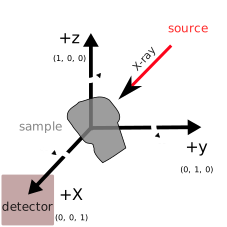
When McStas coordinate system is the following:
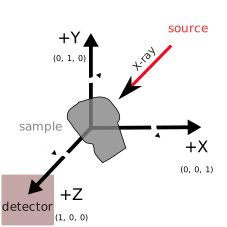
Warning
HDF5 may have broken links in virtual layout. By default, this class performs an integrity check on all the links, and this can be very long for huge data sets with tens of thousands of links. This check can be set by defining and export in the shell environment variable TOMOTOOLS_SKIP_DET_CHECK set either to 1 or y.
- Parameters:
scan (
Optional[str]) – path to the nexus file.entry (
str) – name of the NXtomo entry to select. If given index is ignored.index (
Optional[int]) – of the NXtomo entry to select. Ignored if an entry is specified. For consistency entries are ordered alphabeticallynx_version – Version of the Nexus convention to use. By default (None) it will take the latest one
ignore_projections (
UnionType[dict,list,tuple,ndarray,None]) – projection indices to be ignored. If a list of integers is provided: exclude the projections corresponding to these indices in “image_key”. Otherwise, a dict should be provided in the form {“kind”: kind, “values”: values} where “kind” can be: “indices”, “angles”, “range”.
- __init__(scan, entry=None, index=0, ignore_projections=None, nx_version=None)#
Methods
__init__(scan[, entry, index, ...])build icat metadata dictionary filling NXtomo definition following icat definition: https://gitlab.esrf.fr/icat/hdf5-master-config/-/blob/88a975039694d5dba60e240b7bf46c22d34065a0/hdf5_cfg.xml
clear caches.
clear_caches()- rtype:
None
clear_frames_cache()clear_frames_caches()- rtype:
None
compute_reduced_darks([reduced_method, ...])- param ReduceMethod method:
method to compute the flats
compute_reduced_flats([reduced_method, ...])- param ReduceMethod method:
method to compute the flats
equal(other)- param instance to compare with :rtype:
bool:return: True if instance are equivalent
flat_field_correction(projs, proj_indexes[, ...])Apply flat field correction on the given data
from_dict(_dict)from_identifier(identifier)Return the Dataset from a identifier
get_bliss_orginal_files()- rtype:
Optional[str]
get_bliss_original_files()- rtype:
Optional[str]
get_bounding_box([axis])Return the bounding box covered by the Tomo object axis is expected to be in (0, 1, 2) or (x==0, y==1, z==2)
get_dark_expected_location()get_dataset_basename()- rtype:
str
get_detector_data_path()- rtype:
str
get_detector_transformations(default)get_distance(*args, **kwargs)get_energy_expected_location()get_flat_expected_location()return the dataset identifier of the scan.
get_ignored_projection_indices()get_master_file(scan_path)get_pixel_size([unit])- rtype:
Optional[float]
get_pixel_size_expected_location()return a dictionary of all the projection.
get_projection_expected_location()return intensity monitor values for projections
get_relative_file(file_name[, ...])- type file_name:
str
get_sample_detector_distance([unit])- param unit:
unit requested for the distance
get_sample_detector_distance_expected_location()get_sample_pixel_size([which, ...])Retrieve x or y sample pixel size.
get_sinogram(line[, subsampling, norm_method])extract the sinogram from projections
get_valid_entries(file_path)return the list of 'Nxtomo' entries at the root level
get_volume_output_file_name([z, suffix])if used by tomwer and nabu this should help for tomwer to find out the output files of anbu from a configuration file.
get_x_flipped([default])get_y_flipped([default])is_abort(**kwargs)- return:
True if the acquisition has been abort
is_tomoscan_dir(directory, **kwargs)Check if the given directory is holding an acquisition
load_from_dict(_dict)Load properties contained in the dictionary.
load_reduced_darks([inputs_urls, ...])load reduced dark (median / mean...) into files
load_reduced_flats([inputs_urls, ...])load reduced flats frames
map_urls_on_scan_range(urls, n_projection, ...)map given urls to an angle regarding scan_range and number of projection.
node_is_nxtomo(node)check if the given h5py node is an nxtomo node or not
save_reduced_darks(darks[, output_urls, ...])Dump computed dark (median / mean...) into files.
save_reduced_flats(flats[, output_urls, ...])Dump computed dark (median / mean...) into files.
set_check_behavior([run_check, raise_error, ...])when user require to access to scan frames NXtomoScan build them (frames property).
set_reduced_darks(darks[, darks_infos])set_reduced_flats(flats[, flats_infos])to_dict()- rtype:
dict
update()Parse the root folder and files to update information
Attributes
DICT_PATH_KEYDICT_TYPE_KEYPCA_FLATS_DATAURLSPCA_FLATS_METADATAURLSREDUCED_DARKS_DATAURLSREDUCED_DARKS_METADATAURLSREDUCED_FLATS_DATAURLSREDUCED_FLATS_METADATAURLSSCHEMEdict of projections made for alignment with acquisition index as key None if not found
Coordinate system used in the NXtomo file.
count_time- rtype:
Optional[list]
dark_n- rtype:
Optional[int]
list of darks files
detector_is_lr_flip- rtype:
bool
detector_is_ud_flip- rtype:
bool
return tuple of Transformation affecting the NXdetector
return y pixel size in meter
return y pixel size in meter
dim_1- rtype:
Optional[int]
dim_2- rtype:
Optional[int]
distance- rtype:
Optional[float]
electric_current- rtype:
tuple
end_timeenergy in keV
entry- rtype:
str
estimated_cor_frm_motorexposure_time- rtype:
Optional[list]
ff_interval- return:
field of view of the scan. None if unknown else Full or Half
number of flat per series (computed on the first series)
list of flats files
return tuple of frames.
if found dict of projections urls with index during acquisition as key
ignore_projectionsimage_key- rtype:
Optional[list]
image_key_control- rtype:
Optional[list]
- rtype:
Optional[str]
intensity_monitorintensity_normalizationReturn the sample name
number of projection WITHOUT the return projections
nexus_pathnexus_version- rtype:
Optional[str]
pixel_size- rtype:
Optional[float]
if found dict of projections urls with index during acquisition as key
Return a compacted view of projection frames.
propagation_distance- rtype:
Optional[float]
reduced_darksreduced_darks_infosreduced_flatsreduced_flats_infosreturn_projs- rtype:
Optional[list]
Return rotation angle (expected counter-clockwise in case we are reading from McStas)
return sample detector distance in meter
if found dict of projections urls with index during acquisition as key
sample x pixel size in meter
sample y pixel size in meter
scan_range- rtype:
Optional[int]
Return the sequence name
index of each frame in the acquisition sequence.
sourcesource_name- rtype:
Optional[float]
source_typesplitted_flat_seriesplit flat according to flat indices
start_timetitlenumber of projection WITHOUT the return projections
- rtype:
str
warning: deprecated !!!!! return True if the frames are flip through x
x_pixel_size- rtype:
Optional[float]
x_real_pixel_size- rtype:
Optional[float]
- return:
Estimated center of rotation estimated from motor position. In [-frame_width, +frame_width]. None if unable to find it
x_translation- rtype:
Optional[tuple]
warning: deprecated !!!!! return True if the frames are flip through y
y_pixel_size- rtype:
Optional[float]
y_real_pixel_size- rtype:
Optional[float]
y translation according to the esrf coordinate system
z translation according to the esrf coordinate system
- FRAME_REDUCER_CLASS#
alias of
HDF5FrameReducer
- property alignment_projections: dict | None#
dict of projections made for alignment with acquisition index as key None if not found
- Return type:
Optional[dict]
- build_drac_metadata()#
build icat metadata dictionary filling NXtomo definition following icat definition: https://gitlab.esrf.fr/icat/hdf5-master-config/-/blob/88a975039694d5dba60e240b7bf46c22d34065a0/hdf5_cfg.xml
- Return type:
dict
- clear_cache()#
clear caches. Might be call if some data changed after first read of data or metadata
- Return type:
None
- compute_reduced_darks(reduced_method='mean', overwrite=True, output_dtype=<class 'numpy.float32'>, return_info=False)#
- Parameters:
method (ReduceMethod) – method to compute the flats
overwrite – if some flats have already been computed will overwrite them
return_info (
bool) – do we return (reduced_frames, info) or directly reduced_frames
- compute_reduced_flats(reduced_method='median', overwrite=True, output_dtype=<class 'numpy.float32'>, return_info=False)#
- Parameters:
method (ReduceMethod) – method to compute the flats
overwrite – if some flats have already been computed will overwrite them
return_info (
bool) – do we return (reduced_frames, info) or directly reduced_frames
- property coordinate_system: tomoscan._CoordinateSystem.CoordinateSystem | None#
Coordinate system used in the NXtomo file.
- Parameters:
default_old_nxtomo – value to return for old nxtomo (<3.0). Before nxtomo 3.0 there was no information about the coordinate system. The ESRF coordinate system was used.
default – default value for recent nxtomo (>=3.0)
- Return type:
Optional[CoordinateSystem]
- property darks: dict | None#
list of darks files
- Return type:
Optional[dict]
- property detector_transformations: tuple | None#
return tuple of Transformation affecting the NXdetector
- Return type:
Optional[tuple]
- property detector_x_pixel_size: float | None#
return y pixel size in meter
- Return type:
Optional[float]
- property detector_y_pixel_size: float | None#
return y pixel size in meter
- Return type:
Optional[float]
- property energy: float | None#
energy in keV
- Return type:
Optional[float]
- equal(other)#
:param instance to compare with :rtype:
bool:return: True if instance are equivalent- ..note:: we cannot use the __eq__ function because this object need to be
picklable
- property field_of_view#
- Returns:
field of view of the scan. None if unknown else Full or Half
- flat_field_correction(projs, proj_indexes, line=None)#
Apply flat field correction on the given data
- Parameters:
projs (
list|tuple|ndarray) – list, tuple or numpy.ndarray of projections (numpy array) to apply correction onproj_indexes (
UnionType[list,tuple,ndarray,None]) – list, tuple or numpy.ndarray of indexes of the projection in the acquisition sequence. Provide None to use the index in the middle of the flats taken.line (
Optional[int]) – index of the line to apply flat filed. If not provided consider we want to apply flat filed on the entire frame
- Returns:
corrected data: list of numpy array
- property flat_n: int | None#
number of flat per series (computed on the first series)
- Return type:
Optional[int]
- property flats: dict | None#
list of flats files
- Return type:
Optional[dict]
- property frames: tuple | None#
return tuple of frames. Frames contains
- Return type:
Optional[tuple]
- static from_identifier(identifier)#
Return the Dataset from a identifier
- get_bounding_box(axis=None)#
Return the bounding box covered by the Tomo object axis is expected to be in (0, 1, 2) or (x==0, y==1, z==2)
- Return type:
tuple
- get_identifier()#
return the dataset identifier of the scan. The identifier is insure to be unique for each scan and allow the user to store the scan as a string identifier and to retrieve it later from this single identifier.
- Return type:
- get_proj_angle_url()#
return a dictionary of all the projection. key is the angle of the projection and value is the url.
Keys are int for ‘standard’ projections and strings for return projections.
- Return type:
Optional[dict]- Returns:
angles as keys, radios as value.
- get_projections_intensity_monitor()#
return intensity monitor values for projections
- Return type:
dict
- get_relative_file(file_name, with_dataset_prefix=True)#
- Parameters:
file_name (
str) – name of the file to createwith_dataset_prefix – If True will prefix the requested file by the dataset name like datasetname_file_name
- Return type:
Optional[str]- Returns:
path to the requested file according to the ‘Scan’ / ‘dataset’ location. Return none if Scan has no path
- get_sample_detector_distance(unit='m')#
- Parameters:
unit – unit requested for the distance
- Return type:
Optional[float]- Returns:
sample / detector distance with the requested unit
- get_sample_pixel_size(which='x', fallback_to_det_pixel_size=True)#
Retrieve x or y sample pixel size.
- Parameters:
fallback_to_det_pixel_size (
bool) – In some case we want to make sure we retrieve a pixel size no matter of the nexus version (when reconstructing in nabu for example). but sometime having an empty value (even if the detector pixel size is given) can also be expected.
- get_sinogram(line, subsampling=1, norm_method=None, **kwargs)#
extract the sinogram from projections
- Parameters:
line – which sinogram we want
subsampling – subsampling to apply. Allows to skip some io
- Return type:
array- Returns:
computed sinogram from projections
- static get_valid_entries(file_path)#
return the list of ‘Nxtomo’ entries at the root level
- Parameters:
file_path (
str) –- Return type:
tuple- Returns:
list of valid Nxtomo node (ordered alphabetically)
..note: entries are sorted to insure consistency
- static get_volume_output_file_name(z=None, suffix=None)#
if used by tomwer and nabu this should help for tomwer to find out the output files of anbu from a configuration file. Could help to get some normalization there
- property group_size#
if found dict of projections urls with index during acquisition as key
- property instrument_name: str | None#
- Return type:
Optional[str]- Returns:
instrument name
- is_abort(**kwargs)#
- Returns:
True if the acquisition has been abort
- static is_tomoscan_dir(directory, **kwargs)#
Check if the given directory is holding an acquisition
- Parameters:
directory (
str) –- Return type:
bool- Returns:
does the given directory contains any acquisition
- load_from_dict(_dict)#
Load properties contained in the dictionary.
- Parameters:
_dict (
dict) – dictionary to load- Return type:
- Returns:
self
- Raises:
ValueError if dict is invalid
- load_reduced_darks(inputs_urls=(DataUrl(valid=True, scheme='silx', file_path='{scan_prefix}_darks.hdf5', data_path='{entry}/darks/{index}', data_slice=None),), metadata_input_urls=(DataUrl(valid=True, scheme='silx', file_path='{scan_prefix}_darks.hdf5', data_path='{entry}/darks/', data_slice=None),), return_as_url=False, return_info=False)#
load reduced dark (median / mean…) into files
- Parameters:
inputs_urls (
tuple) – where to load the reduced darks. A default value is provided by the children class. You better know what you are doing if you modify the default value.metadata_input_urls – where to load the reduced darks metadata. A default value is provided by the children class. You better know what you are doing if you modify the default value.
return_as_url (
bool) – if True then instead of returning the reduced frames as 2D numpy arrays it will return them as a silx DataUrlreturn_info (
bool) – if False only return return the dict of reduced frames (frame index as key (int) and frame as a 2D numpy array or silx Data Url as value) if True then return (dict of reduced frames, darks info / metadata)
Here is an example of usage:
scan = ... # scan must be an instance of TomoScanBase like NXtomoScan()
reduced_darks = scan.load_reduced_darks()
reduced_darks, darks_infos = scan.load_reduced_darks(return_info=True)

dark_frame_np_array = reduced_darks[0]
- Return type:
dict
- load_reduced_flats(inputs_urls=(DataUrl(valid=True, scheme='silx', file_path='{scan_prefix}_flats.hdf5', data_path='{entry}/flats/{index}', data_slice=None),), metadata_input_urls=(DataUrl(valid=True, scheme='silx', file_path='{scan_prefix}_flats.hdf5', data_path='{entry}/flats/', data_slice=None),), return_as_url=False, return_info=False)#
load reduced flats frames
- Parameters:
inputs_urls (
tuple) – where to load the reduced flats. A default value is provided by the children class. You better know what you are doing if you modify the default value.metadata_input_urls – where to load the reduced flats metadata. A default value is provided by the children class. You better know what you are doing if you modify the default value.
return_as_url (
bool) – if True then instead of returning the reduced frames as 2D numpy arrays it will return them as a silx DataUrlreturn_info (
bool) – if False only return return the dict of reduced frames (frame index as key (int) and frame as a 2D numpy array or silx Data Url as value) if True then return (dict of reduced frames, flats info / metadata)
Here is an example of usage:
scan = ... # scan must be an instance of TomoScanBase like NXtomoScan()
reduced_flats = scan.load_reduced_flats()
reduced_flats, flats_infos = scan.load_reduced_flats(return_info=True)
- Return type:
dict
- property machine_current: list | None#
Return the sample name
- Return type:
Optional[list]
- property magnification#
number of projection WITHOUT the return projections
- static map_urls_on_scan_range(urls, n_projection, scan_range)#
map given urls to an angle regarding scan_range and number of projection. We take the hypothesis that ‘extra projection’ are taken regarding the ‘id19’ policy:
If the acquisition has a scan range of 360 then:
if 4 extra projection, the angles are (270, 180, 90, 0)
if 5 extra projection, the angles are (360, 270, 180, 90, 0)
If the acquisition has a scan range of 180 then:
if 2 extra projections: the angles are (90, 0)
if 3 extra projections: the angles are (180, 90, 0)
..warning:: each url should contain only one radio.
- Parameters:
urls – dict with all the urls. First url should be the first radio acquire, last url should match the last radio acquire.
n_projection – number of projection for the sample.
scan_range – acquisition range (usually 180 or 360)
- Return type:
dict- Returns:
angle in degree as key and url as value
- Raises:
ValueError if the number of extra images found and scan_range are incoherent
- static node_is_nxtomo(node)#
check if the given h5py node is an nxtomo node or not
- Return type:
bool
- property path: str | None#
- Return type:
Optional[str]- Returns:
path of the scan root folder.
- property projections: dict | None#
if found dict of projections urls with index during acquisition as key
- Return type:
Optional[dict]
- property projections_compacted#
Return a compacted view of projection frames.
- Returns:
Dictionary where the key is a list of indices, and the value is the corresponding silx.io.url.DataUrl with merged data_slice
- property rotation_angle: tuple | None#
Return rotation angle (expected counter-clockwise in case we are reading from McStas)
- Return type:
Optional[tuple]
- property sample_detector_distance: float | None#
return sample detector distance in meter
- Return type:
Optional[float]
- property sample_name#
if found dict of projections urls with index during acquisition as key
- property sample_x_pixel_size: float | None#
sample x pixel size in meter
- Return type:
Optional[float]
- property sample_y_pixel_size: float | None#
sample y pixel size in meter
- Return type:
Optional[float]
- save_reduced_darks(darks, output_urls=(DataUrl(valid=True, scheme='silx', file_path='{scan_prefix}_darks.hdf5', data_path='{entry}/darks/{index}', data_slice=None),), darks_infos=None, metadata_output_urls=(DataUrl(valid=True, scheme='silx', file_path='{scan_prefix}_darks.hdf5', data_path='{entry}/darks/', data_slice=None),), overwrite=False)#
Dump computed dark (median / mean…) into files.
- Parameters:
darks (
dict) – dictionary with frame indices as key (int) and a 2D numpy array as value.output_urls (
tuple) – tuple of silx DataUrl, where to save the darks. Default value is usually provided by children class directly. You better know what you are doing if you modify the default value.darks_infos – information regarding darks (metadata) like the machine current, exposure time…
metadata_output_urls – tuple of silx DataUrl, where to save the metadata / darks information. Default value is usually provided by children class directly You better know what you are doing if you modify the default value.
overwrtie – if the output files exist then will overwrite them.
Here is an example on how to save your own reduced dark / flat
from tomoscan.framereducer.reducedframesinfos import ReducedFramesInfos
...

scan = ... # scan must be an instance of TomoScanBase like NXtomoScan()
darks_infos.count_time = [2.5]
darks_infos.machine_current = [13.1]
scan.save_reduced_darks(
    darks={
        0: dark_frame,  # dark_frame is a 2d numpy array
    },
    darks_infos=darks_infos,
    overwrite=True,
)
- save_reduced_flats(flats, output_urls=(DataUrl(valid=True, scheme='silx', file_path='{scan_prefix}_flats.hdf5', data_path='{entry}/flats/{index}', data_slice=None),), flats_infos=None, metadata_output_urls=(DataUrl(valid=True, scheme='silx', file_path='{scan_prefix}_flats.hdf5', data_path='{entry}/flats/', data_slice=None),), overwrite=False)#
Dump computed dark (median / mean…) into files.
- Parameters:
flats (
dict) – dictionary with frame indices as key (int) and a 2D numpy array as value.output_urls (
tuple) – tuple of silx DataUrl, where to save the flats. Default value is usually provided by children class directly. You better know what you are doing if you modify the default value.flats_infos – information regarding flats (metadata) like the machine current, exposure time…
metadata_output_urls (
tuple) – tuple of silx DataUrl, where to save the metadata / flats information. Default value is usually provided by children class directly You better know what you are doing if you modify the default value.overwrite (
bool) – if the output files exist then will overwrite them.
Here is an example on how to save your own reduced dark / flat
from tomoscan.framereducer.reducedframesinfos import ReducedFramesInfos
...

scan = ... # scan must be an instance of TomoScanBase like NXtomoScan()
flats_infos = ReducedFramesInfos()
flats_infos.count_time = [2.5, 1.2]
flats_infos.machine_current = [12.5, 13.1]
# for normalization the first reduced flat (at index 1) will have 2.5 as count time and 12.5 as machine current
# the second reduced flat frame (at index 1002) will have 1.2 as count time and 13.1 as machine current
scan.save_reduced_darks(
    darks={
        1: flat_frame_1,     # flat_frame_1 is a 2d numpy array
        1002: flat_frame_2,  # flat_frame_2 is another 2d numpy array
    },
    flats_infos=flats_infos,
    overwrite=True,
)
- Return type:
dict
- property sequence_name#
Return the sequence name
- property sequence_number: tuple[int] | None#
index of each frame in the acquisition sequence. Specific to nexus
- Return type:
Optional[tuple[int]]
- set_check_behavior(run_check=True, raise_error=False, log_level=30)#
when user require to access to scan frames NXtomoScan build them (frames property). Some check can be made during this stage to know if the scan has some broken virtual-dataset (vds) or if the vds is linked to more file than the system might handle.
In this case the ‘vds-check’ can either raise an error or log potential issues with a specific log level
- property source_sample_distance: float | None#
- Return type:
Optional[float]- Returns:
source / sample distance (in meter). Expected to be negative (NXtomo convention).
- property splitted_flat_series: dict | None#
split flat according to flat indices
- Return type:
Optional[dict]
- to_dict()#
- Return type:
dict- Returns:
convert the TomoScanBase object to a dictionary. Used to serialize the object for example.
- property tomo_n: int | None#
number of projection WITHOUT the return projections
- Return type:
Optional[int]
- property type: str#
- Return type:
str- Returns:
type of the scanBase (can be ‘edf’ or ‘hdf5’ for now).
- update()#
Parse the root folder and files to update information
- Return type:
None
- property x_flipped: bool#
warning: deprecated !!!!! return True if the frames are flip through x
- Return type:
bool
- property x_rotation_axis_pixel_position#
- Returns:
Estimated center of rotation estimated from motor position. In [-frame_width, +frame_width]. None if unable to find it
- property y_flipped: bool#
warning: deprecated !!!!! return True if the frames are flip through y
- Return type:
bool
- property y_translation: tuple | None#
y translation according to the esrf coordinate system
Note
coordinate system: NXtomo before 1.5 used to be stored within the esrf coordinate system
- Z axis
^ Y axis | /
x-ray |/ ——–> ——> X axis
but Nexus is using the McStas coordinate system
- Y axis
^ X axis | /
x-ray | / ——–> ——> Z axis
which is now used by NXtomo (and correctly filled with nxtomomill > 1.2.0dev1)
- Return type:
Optional[tuple]
- property z_translation: tuple | None#
z translation according to the esrf coordinate system
Note
coordinate system: NXtomo before 1.5 used to be stored within the esrf coordinate system
- Z axis
^ Y axis | /
x-ray |/ ——–> ——> X axis
but Nexus is using the McStas coordinate system
- Y axis
^ X axis | /
x-ray | / ——–> ——> Z axis
which is now used by NXtomo (and correctly filled with nxtomomill > 1.2.0dev1)
- Return type:
Optional[tuple]